INTIMACY

Year: 2022
Location: Culturgest Culture Centre, Lisbon
Client: Lisbon Architecture Triennale Terra
Participants: Aristide Antonas, Bruno Munari, Mila Baumann, Ulimate Compost,Rohan Chavan, Tokyo Toilet

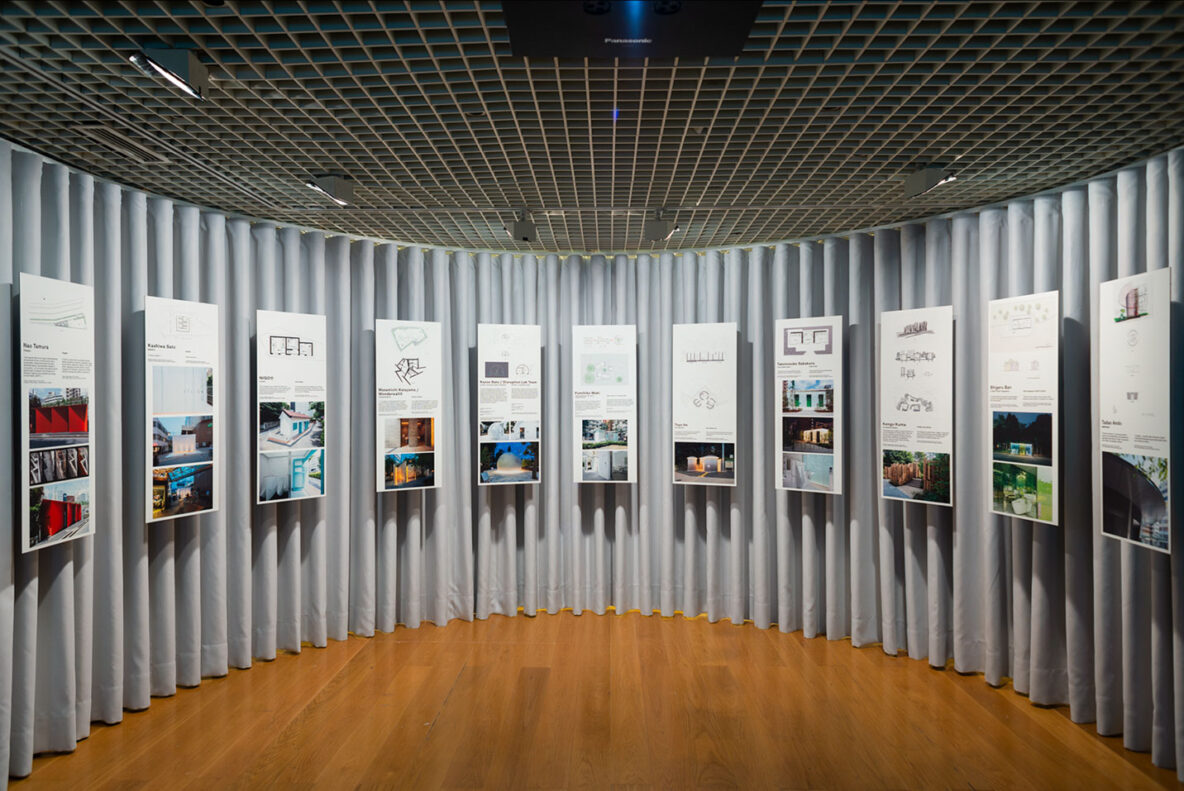
In this mini-exhibition we trace subtle changes that affect spaces where humans are probably the most 

vulnerable: where we sleep and where we exercise our understanding of hygiene. Architectural visionaries rarely pay attention to such prosaic places: it is not easy to revolutionise a public toilet or imagine a bedroom that would fundamentally improve the lives of many. So are they important at all? 

In fact, with the perspective of future global pandemics and world-wide refugee crises, new visions for places with the most mundane functions are in high demand. Institutions and individual authors who develop the next prototypes for functional intimacy –  be it a bed-module for a patient with contagious disease or a restroom for immigrant workers – are doing their visionary duty.

Understanding intimate spaces better might also help on another level. Simple, ubiquitous structures such as, for instance, public toilets expose many of the most acute planetary issues – from social and economic to sustainability- and ecology-related – and allow us to address them quickly, on a really small scale, but with potentially grand effect.

Reimagining Hygiene 

In his seemingly modest prototypes for public restrooms young indian architect Rohan Chavan addresses many issues that are central to today’s architectural discourse. Designing for the poorer classes, he tries to imagine intimate spaces which would provide security and simple comforts to those deprived of the most basic amenities in every urban block in contemporary India. His restrooms are cheap to manufacture, democratic, sustainable, ecologically sound, and, at the same time, visually engaging. He even hopes to make them function as tiny public spaces, expanding on existing customs as well as on predictions of the more universal future demands.  

The traditional understanding of hygiene in India (and more generally in Asia) is rather different from what we propagate today in the West, so the Chavan Architects team is investigating possibilities to bridge different paradigms through functional architectural schemes. Despite their small scale, these public projects become educational devices of sorts, demonstrating to citizens, municipal workers, and designers that break-through architectural solutions can be simple, come at low costs, and still dramatically improve the quality of life in cities.

Beyond (Dis)Abilities

Initiated by Koji Yanai, an innovative design thinker and a son of the UNIQLO founder, the Tokyo Toilet project grew out of the brainstorming towards the Paralympic games 2020 in Japan. Tokyo is not the most comfortable city for disabled people and the initial idea was to update it by means of various public projects targeted at visitors with special needs. 

However, over time the concept changed and the team decided to create a set of innovative restrooms accessible to all to demonstrate what such mundane facilities could become in the future. While the beauty of traditional Japanese toilets was praised by poets and writers, modern city toilets were never subject to conscious design. 

The project brief set high standards for sustainability, also calling for new safe experiences for the public and effective strategies for maintenance. Next to famous architects, Koji Yamai  invited art and creative directors of companies as well as product, fashion, and interior designers, claiming that various professionals should tackle the assignment from different perspectives.  

A voice-operated toilet, a safe toilet for a kid, a toilet made out of recycled wood, and a glass toilet that can change the transparency of its walls when in use  – these are the most popular visual memes of the project. Whether you like this architecture or not, Tokyo Toilet as an initiative seems to state something important: we need daring visions even for the most intimate spaces. 
The Victory of the Bed

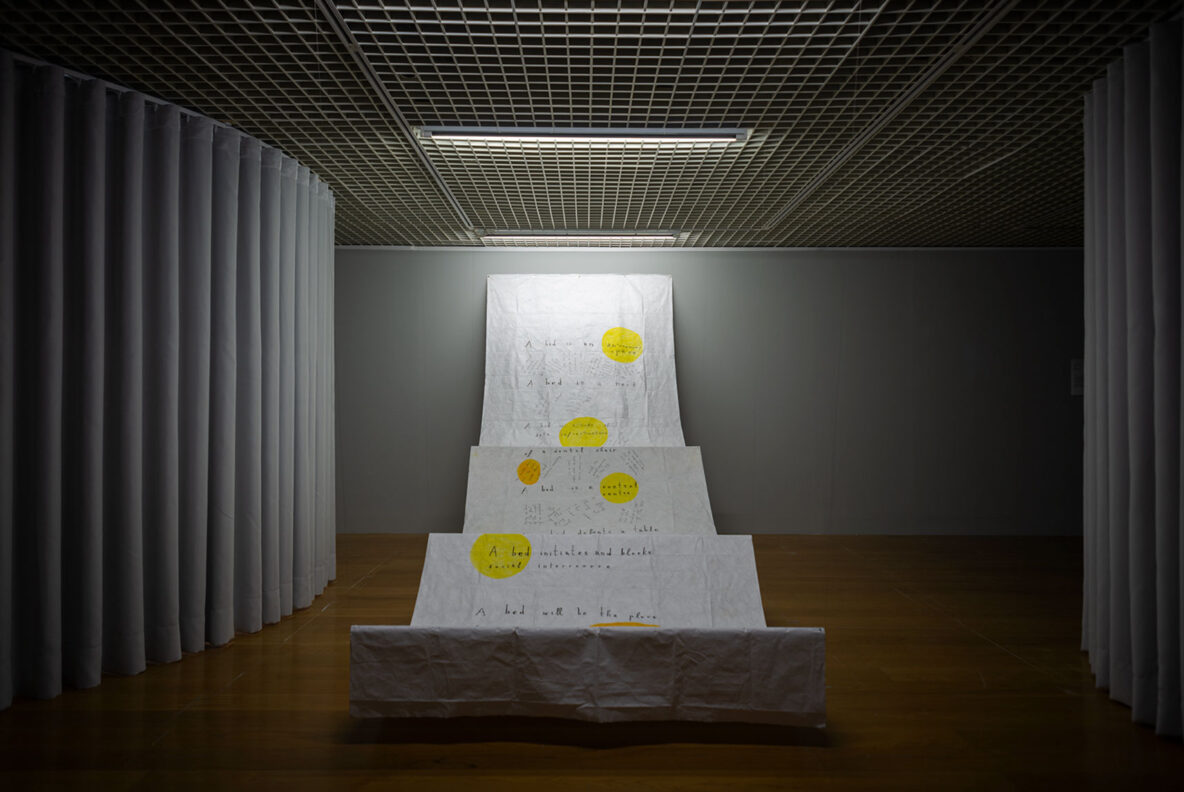
For a number of years, the Berlin-based Greek architect Aristid Antonas has been researching contemporary everyday routines, trying to understand how small changes in mundane protocols might lead to tectonic shifts in the production of space. Central to this investigation is his conceptualisation of a bed as the next social space and an interface between overlapping worlds: from that of dreams (and insomnia) to many online and offline realities. 

At the special invitation of SVESMI, Aristid Antonas produced the installation Bed Manifesto, in which he imagines the future of the bed as the most basic spatial unit and elaborates upon the ideas from his previous projects, including the early Crane Rooms concept.   

Photo: Nuno Cera, Sara Constanza 
Visionaries Lisbon Triennale

back